Circuit Scavengers
Electricity and magnetism
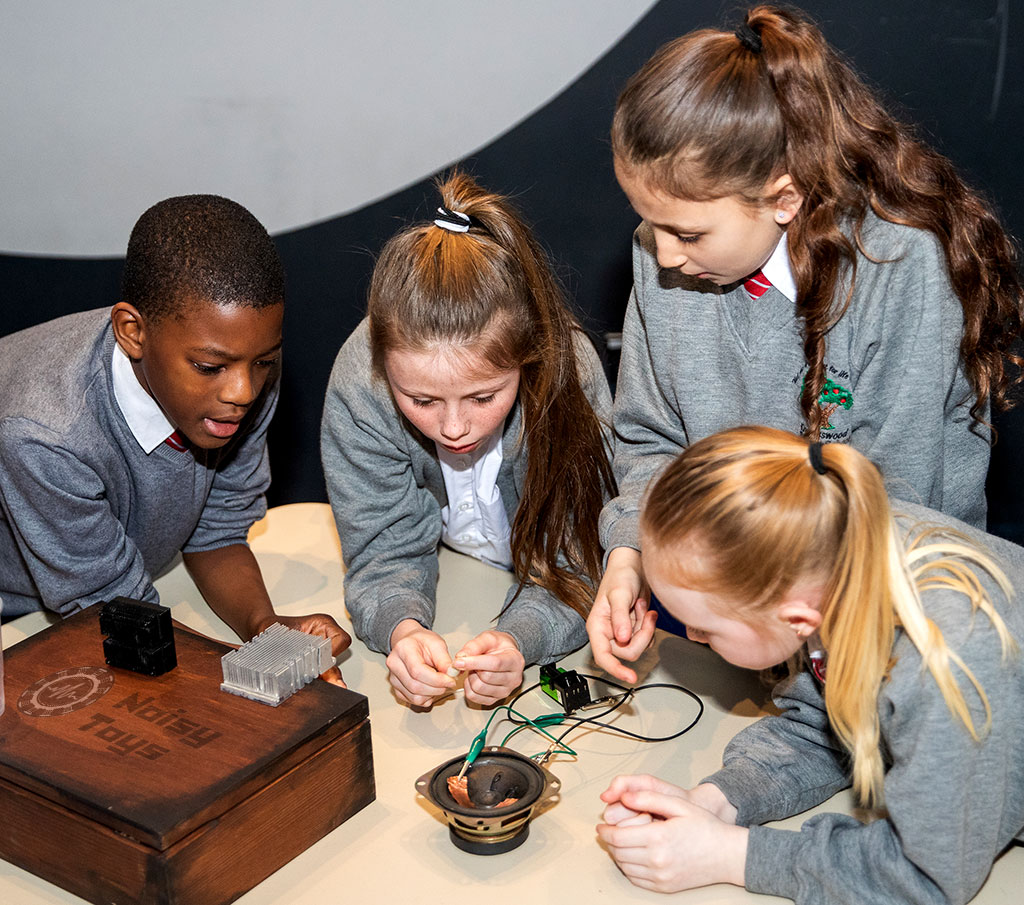
Hands-on noisy activities using e-waste. We test materials, wire up a loudspeaker, make a Robot Chicken, and spin up-cycled cooler fans, discovering how electricity and magnetism work together.
Facts
- Group size: 35 or a whole class (more with an extra leader or school support)
- Duration: 45 – 60 minutes
- Combine with Scavenger Sounds for a 90 – 120 minute session
- £350 for 2 X 1 hour workshops, or show and workshop
- £75 for each extra workshop
What happens in the workshop?
Starter: Nose Test
A whole-class conductivity experiment. We test materials (including noses) for conductivity, adjust the flow of electricity with our hands, and act out circuit parts as a human circuit. Everyone receives a “Nose Tested” stamp.
Main Activity: Robot Chicken
In groups of three, we connect a speaker to an electrical circuit to see what happens, then reverse the polarity and record their results. What is pushing and pulling the speaker cone? We use a fake magic trick to expose the hidden force at work. Then we connect our speaker to feedback, producing a Robot Chicken (it sounds horrendous!). Why does it sound like that? The circuit works in the same way as a buzzer, but with variable pitch.
Extra Activities and Demonstrations
- electrical safety
- e-waste; what is it?
- magnetic poles to push and pull
- inside a broken speaker
- hacked hardware; motors working backwards to generate electricity
Extra activities, Variations and Extensions
We cannot fit all of these into 60 minutes but you can choose if you have a preferred focus for the workshop. Most of these are suited to KS3.
- electrical safety; we cover this in all workshops, but can focus in more detail
- e-waste; global issues around disposable electronics, and the children who work with our waste, faraway
- electromagnetism; speaker coils give a perfect demonstration of how the electrical and magnetic forces are combined (prep for KS4)
- connect fans to the circuit to see another use of electricity and magnetism making things move
- connect bulbs and voltage regulators to the circuit to see the effect of varying voltage on brightness
- connect switches to our circuits to turn the current flow on and off.
- electromagnetic induction (prep for KS4) using a speaker as a microphone
Plenary
- We recap key words and concepts. After the workshop teachers can be sent a re-cap worksheet to help students recall key information and to relate words and concepts to the activities from the workshop.
Lower Key Stage 2
National Curriculum links
- Year 4 Electricity: identify common appliances that run on electricity
- Year 4 Electricity: constructing a simple series circuit, naming parts including buzzers and motors; a complete loop; switches; conductors and insulators; common appliances; working safely
- Year 3 Forces and magnets: magnetic forces act at a distance; magnets attract and repel; poles; predicting attract or repel from which poles face
- Working scientifically: observing, recording findings, simple conclusions
Learning Objectives
- Sort materials into conductors and insulators, and explain why a circuit needs a complete loop
- Connect a speaker to a circuit, then observe and record what happens when the battery connections are swapped
- Describe the speaker cone being pushed and pulled by magnets, using the ideas of attract and repel
- Spot motors and speakers in everyday appliances, and say how to be safe with electricity
Upper Key Stage 2
National Curriculum links
- Year 6 Electricity: how components behave in a circuit; brightness and volume linked to the number and voltage of cells; changing one component at a time; circuit symbols; working safely
- Year 5 Properties and changes of materials: comparing materials by conductivity and response to magnets
- Year 3 Forces and magnets (revisited): poles, attract and repel
- Working scientifically: recording results systematically, using evidence, how ideas developed over time
Learning Objectives
- Rank materials by conductivity, and predict how a variable control changes the result
- Record what happens to the speaker cone and the fan when polarity is reversed, and explain the pattern using magnetic forces
- Describe the Robot Chicken as a circuit that keeps switching itself on and off, and compare it with a buzzer or electric bell
- Draw circuits using recognised symbols, and talk about how Victorian inventions relate to devices today
Key Stage 3
National Curriculum links – Science
- Physics, Current electricity: current, potential difference and resistance (resistance as the ratio of p.d. to current); conducting and insulating components
- Physics, Magnetism: poles, magnetic fields, the magnetic effect of a current, electromagnets, and the principles of DC motors
- Physics, Forces: non-contact forces between magnets
- Physics, Energy changes and transfers: completing an electrical circuit
- Chemistry, Earth and atmosphere: limited resources and the efficacy of recycling
- Working scientifically: evaluating risks; using and evaluating models
Cross-curricular & Extension
- Introduction to electromagnetism; in advance of KS4
- Power generation using turbines
- Raising awareness issues around global e-waste, consumption and planned obsolescence
Learning Objectives
- Compare the resistance of materials, and explain how a variable resistor controls current
- Explain that a current in a coil makes an electromagnet, so reversing the current reverses its poles and the force on the speaker cone
- Describe how the same principle drives a DC motor
- Explain the Robot Chicken as a self-interrupting circuit, producing vibrations at audio frequency
- Evaluate electrical risks, discuss the resource cost of discarded electronics, and evaluate the human circuit as a model