Circle Music
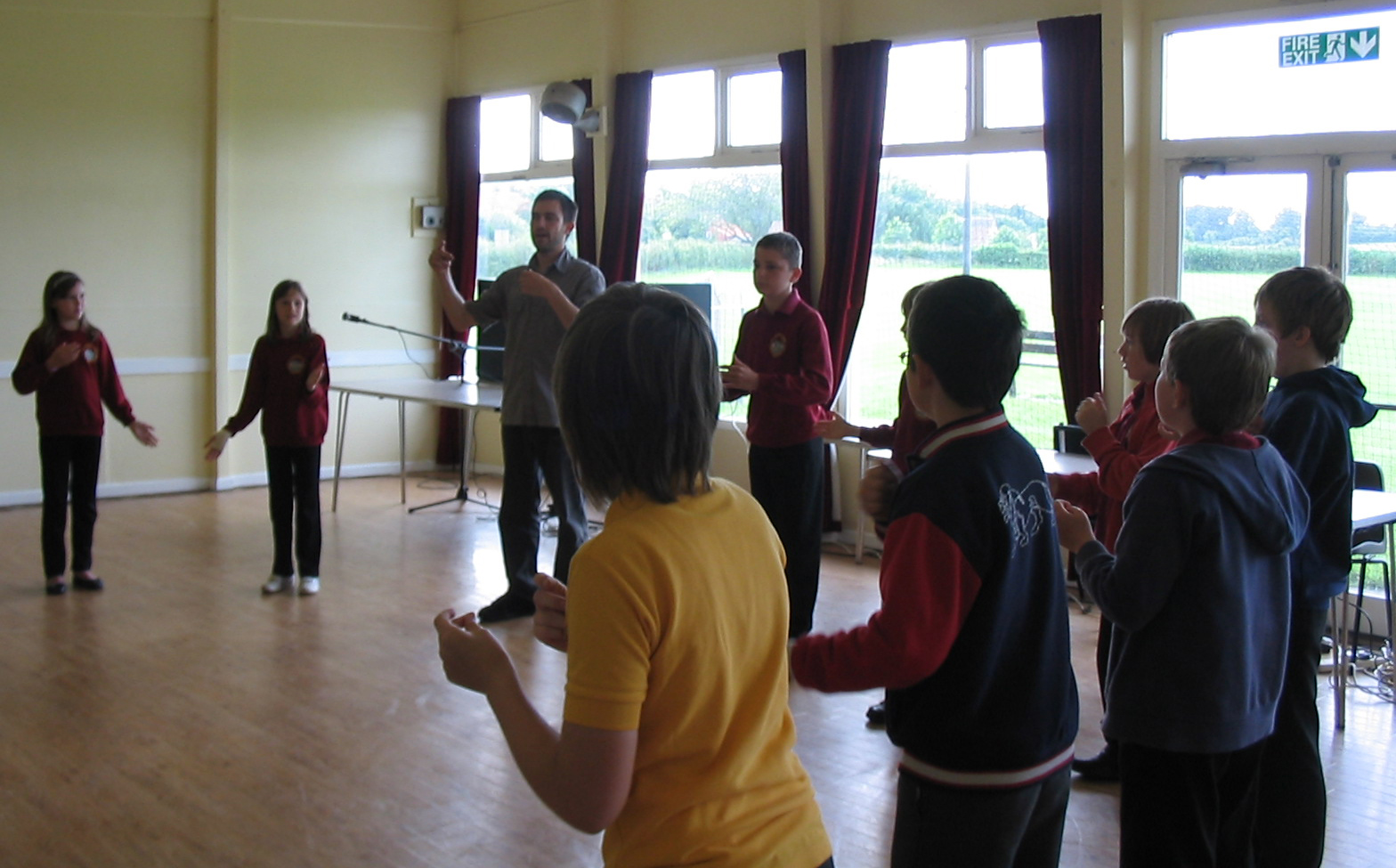
Musical games using voices & bodies
NO RESOURCES REQUIRED! We have everything we need already.
Games and group activities that help develop core musical skills and non-verbal communication. Developing the ‘inner ear’ to find pitch and feel rhythm. Building confidence to use our voices and to express our own ideas in a musical context.
Facts
- Group size: 16 / half class
- Duration: 15 – 45 minutes
- £350 for 2 hours of workshops, or show and workshops
- £75 for each extra hour of workshops
What happens in the workshop?
This is a very flexible workshop with varied games, songs and activities suited to all ages, and also adaptable for an existing musical ensemble or students who study music and are looking for new techniques inspiration.
Rhythm:
Counting and adding simple sounds, until we can count internally
Playful activities that encourage a sense of rhythm, use of non-verbal communication
Lower Key Stage 2
National Curriculum links
- Year 4 Electricity: identify common appliances that run on electricity
- Year 4 Electricity: constructing a simple series circuit, naming parts including buzzers and motors; a complete loop; switches; conductors and insulators; common appliances; working safely
- Year 3 Forces and magnets: magnetic forces act at a distance; magnets attract and repel; poles; predicting attract or repel from which poles face
- Working scientifically: observing, recording findings, simple conclusions
Learning Objectives
- Sort materials into conductors and insulators, and explain why a circuit needs a complete loop
- Connect a speaker to a circuit, then observe and record what happens when the battery connections are swapped
- Describe the speaker cone being pushed and pulled by magnets, using the ideas of attract and repel
- Spot motors and speakers in everyday appliances, and say how to be safe with electricity
Upper Key Stage 2
National Curriculum links
- Year 6 Electricity: how components behave in a circuit; brightness and volume linked to the number and voltage of cells; changing one component at a time; circuit symbols; working safely
- Year 5 Properties and changes of materials: comparing materials by conductivity and response to magnets
- Year 3 Forces and magnets (revisited): poles, attract and repel
- Working scientifically: recording results systematically, using evidence, how ideas developed over time
Learning Objectives
- Rank materials by conductivity, and predict how a variable control changes the result
- Record what happens to the speaker cone and the fan when polarity is reversed, and explain the pattern using magnetic forces
- Describe the Robot Chicken as a circuit that keeps switching itself on and off, and compare it with a buzzer or electric bell
- Draw circuits using recognised symbols, and talk about how Victorian inventions relate to devices today
Key Stage 3
National Curriculum links – Science
- Physics, Current electricity: current, potential difference and resistance (resistance as the ratio of p.d. to current); conducting and insulating components
- Physics, Magnetism: poles, magnetic fields, the magnetic effect of a current, electromagnets, and the principles of DC motors
- Physics, Forces: non-contact forces between magnets
- Physics, Energy changes and transfers: completing an electrical circuit
- Chemistry, Earth and atmosphere: limited resources and the efficacy of recycling
- Working scientifically: evaluating risks; using and evaluating models
Cross-curricular & Extension
- Introduction to electromagnetism; in advance of KS4
- Power generation using turbines
- Raising awareness issues around global e-waste, consumption and planned obsolescence
Learning Objectives
- Compare the resistance of materials, and explain how a variable resistor controls current
- Explain that a current in a coil makes an electromagnet, so reversing the current reverses its poles and the force on the speaker cone
- Describe how the same principle drives a DC motor
- Explain the Robot Chicken as a self-interrupting circuit, producing vibrations at audio frequency
- Evaluate electrical risks, discuss the resource cost of discarded electronics, and evaluate the human circuit as a model