Scavenger Sounds
Sound and Vibrations
Hands-on noisy activities using e-waste. We act out sound waves, strike and amplify everyday objects, uncover hidden sounds, and feel vibrations from a speaker cone.
Facts
- Group size: 35 or a whole class (more with an extra leader or school support)
• Duration: 45 – 60 minutes
• Combine with Circuit Scavengers for a 90 – 120 minute session
What happens in the workshop?
Starter: Human Sound Waves
Rhythm and movement games;. We use our hands and bodies to act out sound waves spreading across the room.
Main Activity
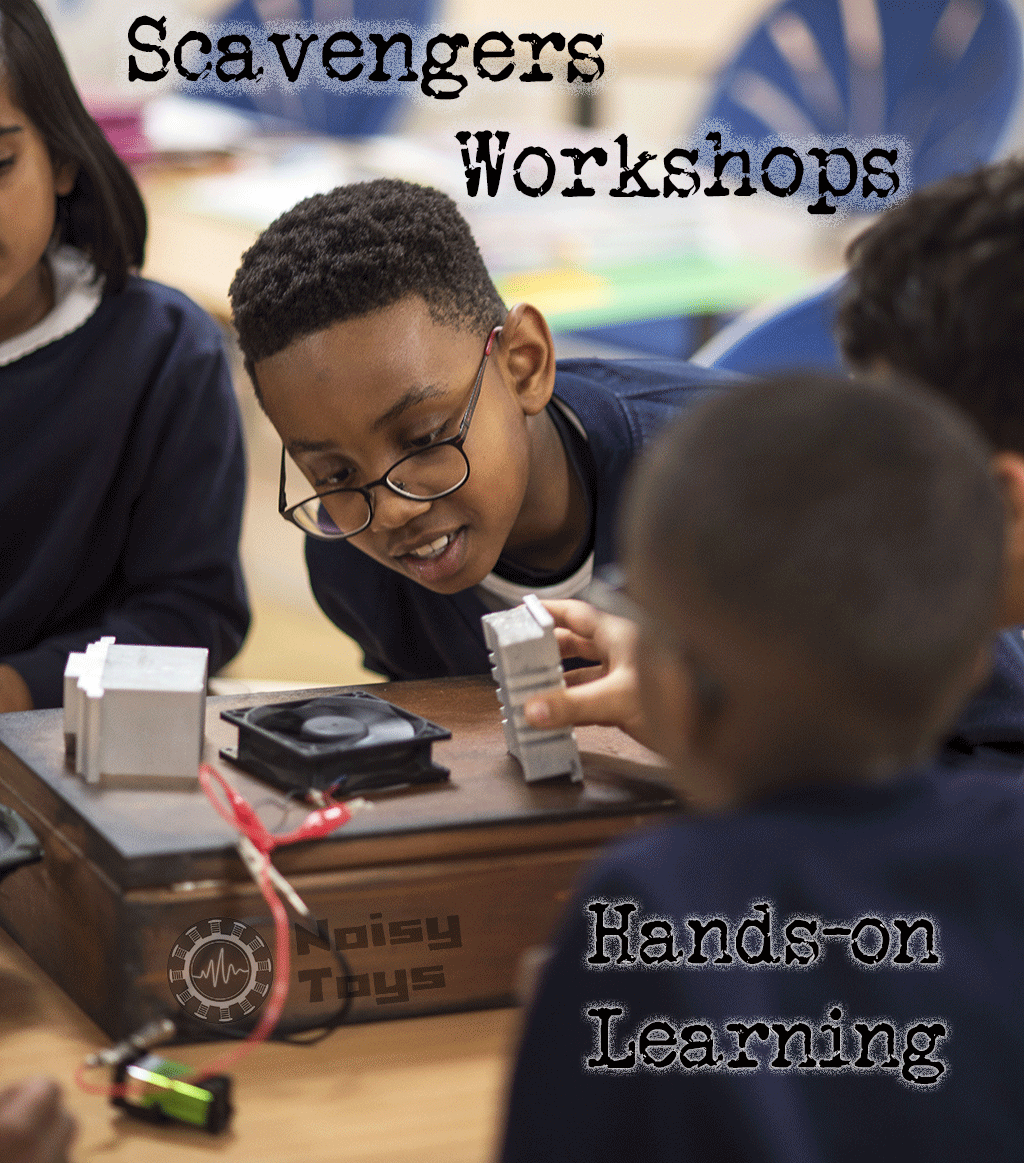
We connect an up-cycled computer fan to a battery and use it to strike acoustic objects (cups, cake tins, heat sinks). Why do different materials make different sounds? Then we use contact microphones and mini amps to find and amplify the sounds we hear. An amplified slinky shows how sound waves behave (differently from water waves), and we find hidden sounds in unusual objects such as rubber bands and egg slicers.
Finale: Bass Buzz
We put our hands inside a vibrating speaker cone and feel the powerful vibrations. As the pitch goes up, they can feel and see the frequency of vibration increase. The energy they feel usually goes into making the air shake, so we can hear the sound waves.
Extra Activities, Variations and Extensions
We cannot fit all of these into 60 minutes but you can choose if you have a preferred focus for the workshop. Most of these are suited to KS3.
- electrical safety; we cover this in all workshops, but can focus in more detail
- e-waste; global issues around disposable electronics, and the children who work with our waste, faraway
- electromagnetism; speaker coils give a perfect demonstration of how the electrical and magnetic forces are combined (prep for KS4)
- ‘Backwards physics’ – electromagnetism works in both directions, so a motor is a generator. We use one to make bass sounds.
- connect voltage regulators to the circuit to adjust the speed of the motors/fans, for musical control of patterns
Lower Key Stage 2
National Curriculum Links
- Year 4 Sound: sounds are made by vibrations; vibrations travel through a medium to the ear; patterns between pitch and the features of an object; volume and the strength of vibration
- Year 4 Sound: finding patterns in the sounds made by objects such as saucepan lids and elastic bands
- Working scientifically: observing, comparing, simple conclusions
Learning Objectives
- Show that sounds are made by vibrations by feeling them in the speaker cone
- Describe how sound travels across the room to our ears, using the human wave
- Find patterns between pitch and the size, material or tightness of an object
- Explain that bigger vibrations make louder sounds
Upper Key Stage 2
National Curriculum Links
- Year 4 Sound (applied and extended)
- Year 5 Properties and changes of materials: giving reasons, based on evidence, for the uses of materials
- Year 6 Electricity: the volume of a buzzer linked to the circuit
- Working scientifically: planning fair tests, controlling variables, recording data, using evidence
Learning Objectives
- Plan a fair test of how different materials sound when struck (same striker, same object, one change at a time)
- Record results and use them to explain why materials sound different
- Use the human wave as a model of sound, and explain what it shows and what it doesn’t
- Link the pitch and volume they feel in the Bass Buzz to the speed and size of the vibrations
Key Stage 3
National Curriculum Links
- Physics, Observed waves: transverse waves on water
- Physics, Sound waves: frequency in hertz; longitudinal waves; sound needing a medium; vibrations in loudspeakers; detection by a microphone diaphragm; reflection and absorption
- Physics, Energy and waves: pressure waves transferring energy; microphones converting sound to electrical signals
- Working scientifically: using and evaluating models
Learning Objectives
- Compare longitudinal waves (the slinky, sound) with transverse waves (water), and explain why a Mexican wave is a transverse model of a longitudinal wave
- Relate frequency to pitch and amplitude to loudness, and estimate frequencies in hertz
- Explain how materials affect sound, including absorption and reflection
- Explain how a contact microphone converts vibrations into electrical signals, and how the energy of a vibrating cone is transferred to the air
Enrichment note for teachers: using a speaker as a microphone introduces electromagnetic induction, which is mainly Key Stage 4 content.